Wholesale vs. Consignment: Which Is Better for a Small Business?
If you’re trying to get your products into retail stores, you’ll eventually hear two words over and over again: wholesale and consignment.
They can put your products on the exact same shelf, but financially, they are very different arrangements.
For a new product-based business, understanding that difference matters. A retail deal can look exciting on paper while quietly tying up hundreds or even thousands of dollars in inventory.
Here’s what small brands should understand before saying yes

What Is Wholesale?
Wholesale is the traditional retail model.
A retailer buys inventory from your business at a discounted wholesale price and then resells those products to its customers at the retail price.
For example:
Your perfume retails for $20.
A boutique purchases it from you for $10.
The boutique then sells it for $20.
You receive your $10 regardless of when—or sometimes whether—the retailer eventually sells that particular unit.
That last part is important.
Once the wholesale transaction is complete, the retailer has taken on much of the inventory risk.
Example of a Wholesale Order
Imagine a boutique orders:
50 units × $10 wholesale = $500
You receive $500 from the retailer according to your agreed payment terms.
If the store eventually sells all 50 products for $20 each, it generates:
50 × $20 = $1,000 in retail sales
The difference between the retailer’s purchase cost and selling price provides room for the retailer’s gross margin and operating expenses.
For the brand, the advantage is straightforward:
You’ve sold 50 units at once.
What Is Consignment?
Consignment works differently.
Instead of the retailer purchasing your inventory upfront, you place your products inside the store while generally retaining ownership of them until they’re sold.
When something sells, the store keeps an agreed percentage and pays you the remainder.
For example, suppose a product retails for $20 and your agreement uses a 60/40 split, with 60% going to the brand.
When the product sells:
Brand receives: $12
Retailer receives: $8
At first glance, that might look better than wholesaling the same product for $10.
But there’s a catch.
You only get paid when the product sells.
If you send 50 units to the store and only five sell that month, you’re only being paid for those five units.
The remaining 45 units represent inventory—and money—still tied up in that location.
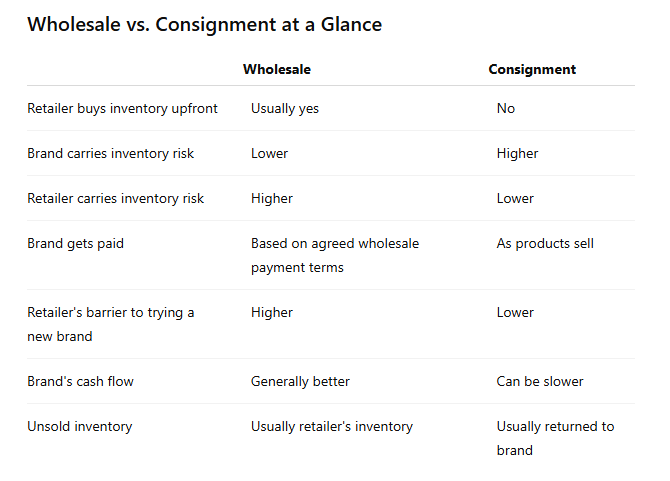
Why Retailers Like Consignment
It’s easy to understand why a store might be interested in consignment.
Imagine you’re a boutique owner and an unfamiliar brand approaches you.
You’ve never carried the product.
You don’t know whether customers will like it.
You don’t know how quickly it will sell.
With wholesale, you’re being asked to put your own money into that inventory.
With consignment, much of that risk remains with the brand.
The retailer gets to test the products on its customers without making the same upfront inventory investment.
For an emerging brand, that can make it easier to get a foot in the door.
Why Consignment Can Be Attractive for a New Brand
Consignment isn’t automatically a bad deal.
In fact, I think it can be a useful strategy when used intentionally.
Imagine two scenarios.
Store A says:
“We’ve never heard of your brand, so we’re not comfortable placing a wholesale order.”
Store B says:
“We’ll test your products for 90 days on consignment.”
Store B gives you something valuable: real-world sales data.
You’ll learn whether customers actually pick up your product, which variations sell, what price points work, and whether that store’s audience matches your brand.
If the products perform well, you now have evidence you can use when discussing a future wholesale relationship.
The Hidden Cost of Consignment
Here’s where small businesses need to be careful.
Suppose your product costs you $4 to manufacture.
You send 50 units to a store.
You’ve now put:
50 × $4 = $200
of your own inventory cost into that location.
Now imagine doing the same thing with ten stores.
That’s:
$2,000 worth of inventory
sitting outside your business without necessarily having been sold.
And that’s before considering packaging, shipping, testers, displays and your time.
This is why rapidly accumulating consignment accounts can create the illusion that a business is growing while its cash flow is actually becoming tighter.
You can proudly say:
“We’re in 30 stores!”
But the more important question is:
How much are those 30 stores actually selling?
A Higher Percentage Doesn’t Automatically Mean a Better Deal
This is another mistake that’s easy to make.
Suppose you have these two opportunities:
Wholesale: You receive $10 immediately for a $20 product.
Consignment: You receive $12 when the $20 product sells.
The consignment arrangement appears better because you’re potentially receiving $2 more per unit.
But you’re also providing the inventory without receiving payment upfront.
If the product sits there for six months, that $12 doesn’t mean much for your current cash flow.
When comparing arrangements, consider more than the percentage.
Think about:
How quickly the store sells products
How frequently they pay
How much inventory they require
Shipping costs
Tester costs
Damaged or missing products
Your manufacturing cost
How long your inventory will remain there
The highest percentage isn’t necessarily the most profitable arrangement.
When I Would Consider Consignment
I see consignment primarily as a customer-acquisition and market-testing strategy, not something a growing brand should automatically offer to every retailer.
It can make sense when the store is an excellent fit, the location gives your brand meaningful exposure, the initial inventory commitment is manageable, or you want real sales data before proposing wholesale.
I’d be much more cautious if a store wants a large amount of inventory, has unclear payment procedures, can’t provide reliable sales reporting, or expects the brand to absorb every possible expense.
Your inventory has value.
Treat it like money.
When Wholesale Is Better
As a product business becomes established, wholesale is usually much easier to scale.
Instead of financing inventory for numerous retailers, you’re manufacturing products that customers—your retail accounts—have actually purchased from you.
Wholesale can also make forecasting easier.
If five stores each place a $500 order, you’ve generated $2,500 in wholesale revenue.
With consignment, sending $2,500 worth of retail inventory to stores doesn’t mean you’ve generated $2,500 in sales.
Nothing has technically sold to the end customer yet.
That’s an important distinction.
Can You Convert Consignment Stores to Wholesale?
Yes—and this can be one of the smartest ways to use consignment.
Instead of treating consignment as a permanent arrangement, you can establish a trial period.
For example:
90-day consignment trial → review sales performance → discuss moving to wholesale.
If your products consistently sell, the conversation changes.
You’re no longer asking the retailer to gamble on an unknown product.
You can say:
“These products have been performing consistently with your customers. Would you like to transition future restocks to wholesale?”
Now you have actual sales data supporting the request.
Always Have a Written Consignment Agreement
Don’t drop off hundreds of dollars of inventory based on a handshake and an Instagram conversation.
At minimum, your agreement should clearly establish:
Who owns the inventory
Retail prices
Revenue split
Payment schedule
How sales are reported
Inventory quantities
Responsibility for damaged or missing products
Shipping responsibilities
Length of the consignment period
How either party can end the agreement
What happens to unsold inventory
Take inventory records seriously.
If you sent 40 units, sold 12 and received eight back, you should be able to account for the other 20.
So, Is Wholesale or Consignment Better?
If you’re asking purely from a scalability and cash-flow perspective, wholesale is generally the stronger model for the brand.
You sell the inventory and receive payment according to your wholesale terms.
But that doesn’t make consignment useless.
For a young brand, consignment can be a powerful way to remove some of the retailer’s risk, get products into carefully selected stores, gather sales data, prove demand, and build relationships that can eventually become wholesale accounts.
The mistake isn’t necessarily using consignment.
The mistake is sending inventory everywhere without measuring whether those stores are actually producing sales.
A small brand with 10 productive retail accounts can be in a much healthier position than a brand claiming to be in 100 locations where inventory barely moves.
Don’t chase the number of stores.
Chase sell-through, reorders and profitable relationships.


Comments
Post a Comment